




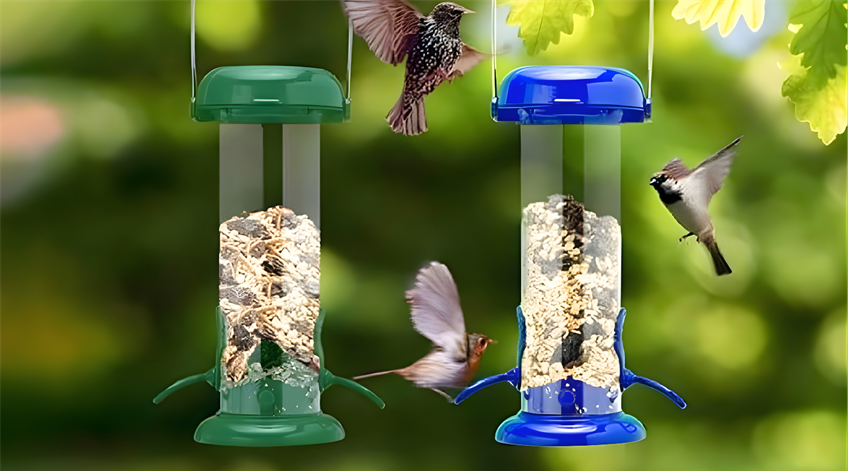
Recent guidance from the RSPB advises the public to stop feeding garden birds during spring and summer as a way to try to reduce the spread of trichomoniasis.
As a result, as a retailer you might start to hear questions from customers about bird feeding and the disease. As people who care deeply about wildlife, it's important to look at this clearly, based on how nature actually works. We want to help you and your customers to understand the RSPB advice, whilst also being aware of its flaws.
Understanding the Disease
Trichomoniasis is caused by a parasite that infects the upper digestive tract of birds, that prevents birds from swallowing food and water and ultimately leading to death by starvation. It is without question a serious disease, but it is also not new, not emerging, and not preventable in the way that the RSPB's guidance implies.
The parasite causing this disease has existed in UK bird populations for decades, particularly in pigeons and doves which act as reservoir hosts. The issue we have seen since 2005 was not the arrival of the disease itself, but a shift in strain and host impact - particularly affecting finch species like greenfinches.
Since then, trichomoniasis has become endemic, meaning it is now a permanent, naturally circulating disease within wild bird populations.
This distinction matters, because endemic diseases cannot be managed away through short-term behavioural changes like removing bird feeders.
The Flaw in the RSPB Approach
Removing feeders does not remove the transmission of trichomoniasis - it relocates it. If you remove supplementary feeding, birds don't disperse neatly into the landscape but instead concentrate around fewer, more predictable food sources. This leads to:
- Higher bird densities in smaller areas.
- Increased contact rates between individuals.
- Greater competition and stress.
- Higher potential for disease transmission.
A critical and often overlooked point, is that trichomoniasis is fragile outside of a host. In dry conditions it survives for less than an hour, whereas in damp conditions (wet seed, decaying fruit, natural feeding areas), it can survive for up to 48 hours.
To be clear, this means that a clean, dry feeder with fresh seed is a relatively low-risk environment, compared to a damp natural feeding site which is much higher risk. Therefore by removing feeders, we are not eliminating exposure, we are potentially just pushing birds toward conditions that favour parasite survival.
So, what should be done?
There are genuine, evidence-based ways to reduce transmission risk. One of the biggest factors in this is food quality. A huge proportion of bird food on the market contains filler seeds (often wheat and oats), that most birds cannot eat. These seeds are discarded from feeders, become contaminated, are picked up by other birds, and therefore transmission risk increases significantly.
Remove the fillers, and you remove part of the problem.
Peter and Paul was designed to contain no filler seeds whatsoever. Everything in their seed mixes is edible, meaning there is significantly less waste and fewer contaminated surfaces.
Clean feeders properly, using the right product.
Feeders should be cleaned at least once per week, using a targeted disinfectant which is designed to kill pathogens. Feeders should be fully dismantled and all contact points cleaned. They should then be allowed to dry fully before refilling. If a sick bird is observed, remove all feeders immediately and disinfect them thoroughly. Pause feeding for a period during this time.
Feed little and often, keeping everything fresh and dry.
One of the simplest but most effective changes people can make, is by ensuring they do not fill feeders completely, but instead only provide a day's worth of food at a time. Discard any seed that becomes damp or clumped.
Use multiple feeding points.
Concentrated feeding leads to concentrated risk. A better approach is to use multiple smaller feeders, spread across the garden to reduce clustering. Manage the area around the feeders to ensure any husks or debris are cleared away. With Peter and Paul, this issue is significantly reduced because there are no filler seeds being thrown out in the first place.
Provide fresh water.
Natural water sources can hold the parasite for extended periods, especially when contaminated with organic matter. It is best to provide fresh tap water daily, and regularly disinfect bird baths with a targeted pathogen spray.
All in all, responsible, well-managed feeding supports bird health while poor practises increase risk. Done correctly, we believe feeding continues to be a positive way to support garden birds.
Leave us your comment
You need to login to add a comment.
Comments
There are currently no comments, be the first to comment.